Unit Price Is Not Landed Cost: How to Compare a Vietnam Quote
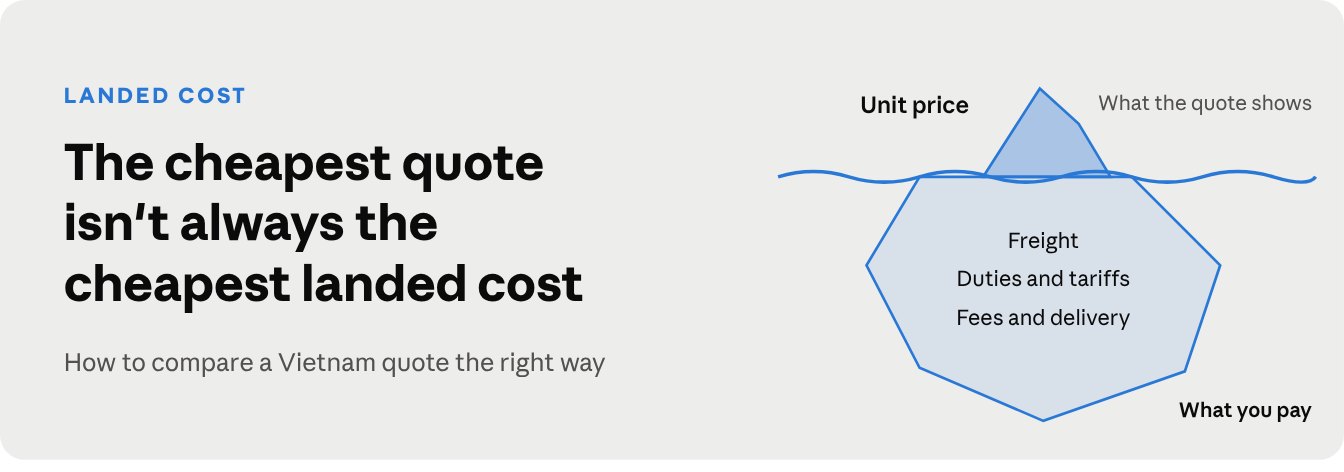
The most common mistake we see when buyers compare an overseas quote with their current supplier is comparing unit price to unit price. The number that matters is landed cost: what each unit actually costs once it is sitting on your dock, ready to use.
A quote that looks 20% cheaper at the factory gate can end up even, or more expensive, once freight, duties and fees are added. The reverse is also true: a slightly higher unit price on better terms can win.
What goes into landed cost
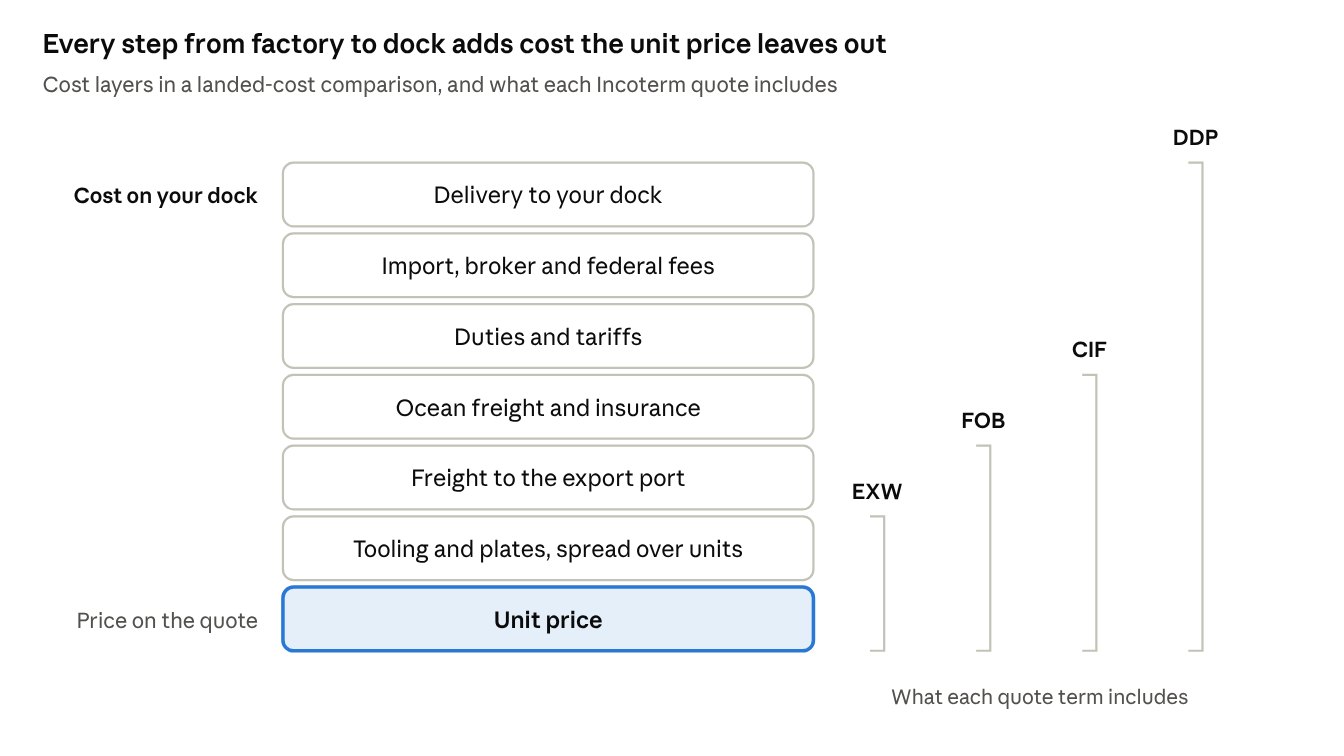
Unit price. The factory price per piece at the agreed order quantity.
One-time costs. Tooling, printing plates, cylinders or dies, spread across the units you expect to buy.
Freight to the port. Trucking from the factory to the export port, if not included.
Ocean freight and insurance. Container or LCL rates, which swing with the market.
Duties and tariffs. Set by your product's HTS code and country of origin.
Import fees. Customs broker fees plus small federal fees on each entry.
Delivery to your door. Drayage from the US port to your warehouse.
Inventory carrying cost. Longer transit means more stock on the water and on hand.
Read the Incoterm first
Two quotes are only comparable if they are on the same terms. The Incoterm tells you where the supplier's price stops and your costs begin.
| Incoterm | Supplier covers | You cover |
|---|---|---|
| EXW (Ex Works) | Product, ready at the factory | Everything after: loading, export, freight, import, delivery |
| FOB (Free on Board) | Product delivered and loaded at the export port | Ocean freight, insurance, import duties, delivery |
| CIF (Cost, Insurance, Freight) | Product, ocean freight and insurance to the US port | Import clearance, duties, delivery |
| DDP (Delivered Duty Paid) | Everything to your door, duties included | Unloading |
An EXW quote will always look cheapest on paper because it includes the least. Convert every quote to the same point, ideally your dock, before you compare.
The simple formula
Run it for every option, including your current supplier, using real quantities and the full tariff stack for each country of origin.
Four questions to ask before you switch
What is the minimum order quantity, and how does price change above it? Ocean freight rewards full containers.
What is the real lead time, door to door? Production plus transit plus customs, not just production.
How will quality be verified before shipment? A defect found in your warehouse costs far more than one found at the factory.
Who do you call when something goes wrong? Recourse matters as much as price.
How VIX helps
We quote with the full picture in mind. Our Texas-based team helps you compare options on landed cost, choose the right Incoterm, and plan order quantities that make freight efficient. You get a clear quote, a US point of contact, and production managed on the ground at Dong A and Nam Phuong in Vietnam.
Want a side-by-side comparison against your current supplier? Send us your spec, annual volume and delivery location. Request a quote →
Related product: A packaging supplier alternative to China →
Want this applied to your packaging?
Send your current spec and we'll come back with a factory-direct quote in 5–7 business days.
Get a quote