Moving Production from China to Vietnam: A Practical Transfer Playbook
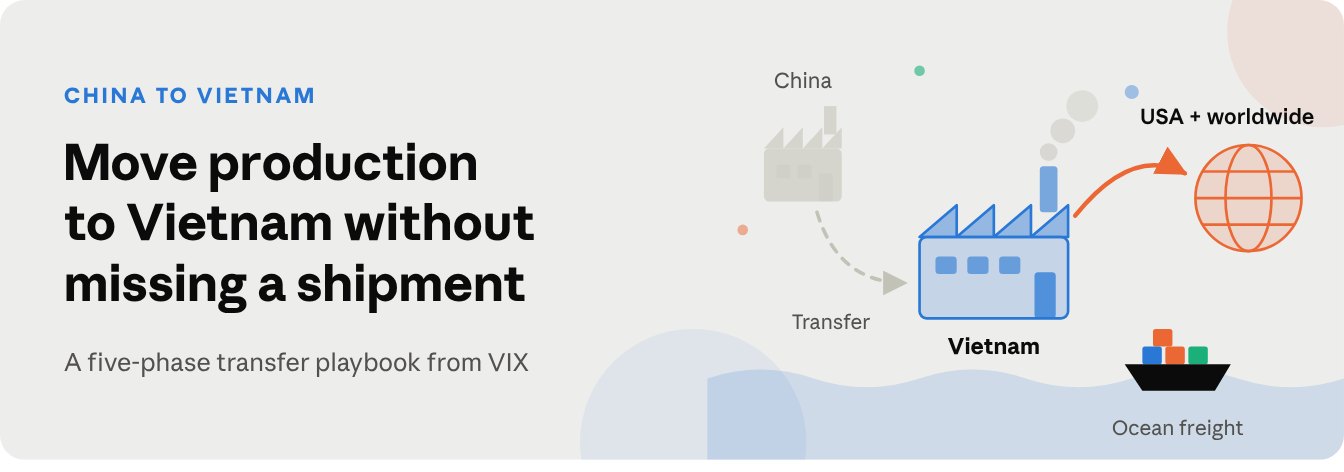
If your products still ship from China, your landed cost is carrying a tariff burden your competitors may have already shed. Moving production to Vietnam is one of the most common answers. Done well, it lowers cost and risk. Done in a rush, it trades one problem for several new ones.
This guide covers why companies are moving, what has changed in 2026, and the step-by-step approach we use to transfer production without interrupting supply.
Why companies are moving now
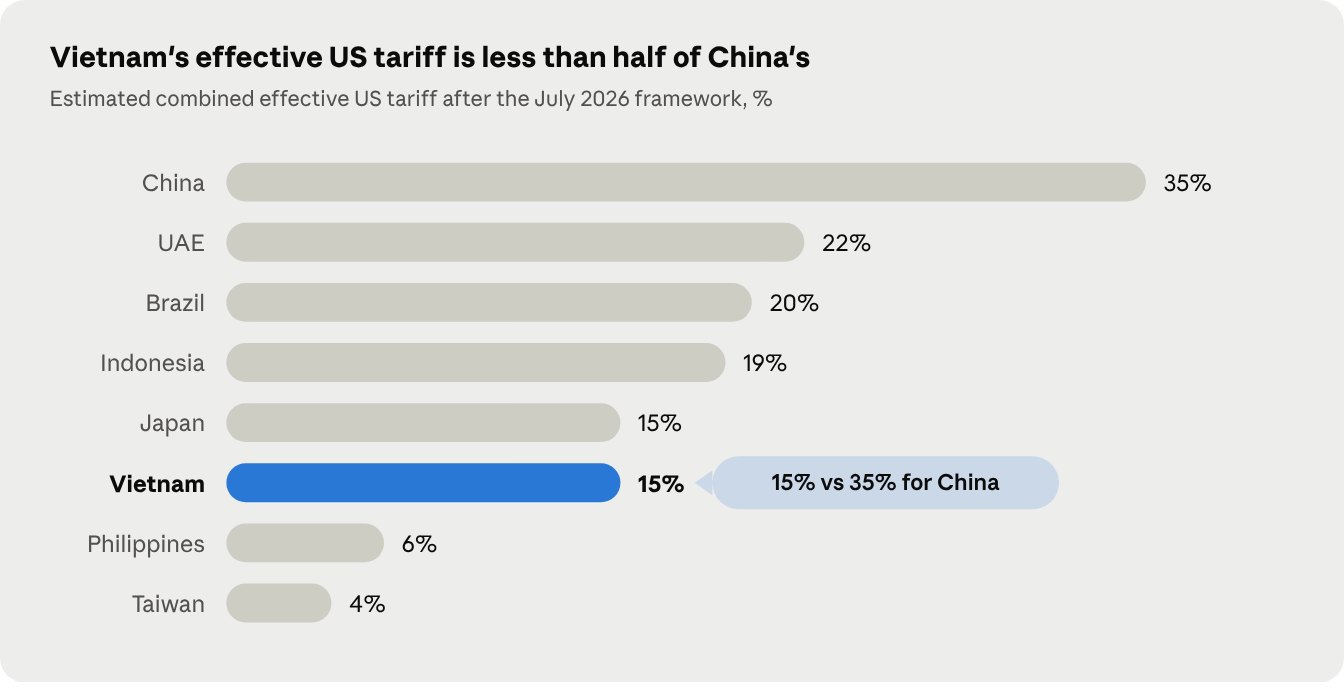
The gap in US tariff exposure is still wide. After the US put a long-term tariff framework in place in late July 2026, Allianz Research estimated China's combined effective US tariff at about 35%, versus about 15% for Vietnam.
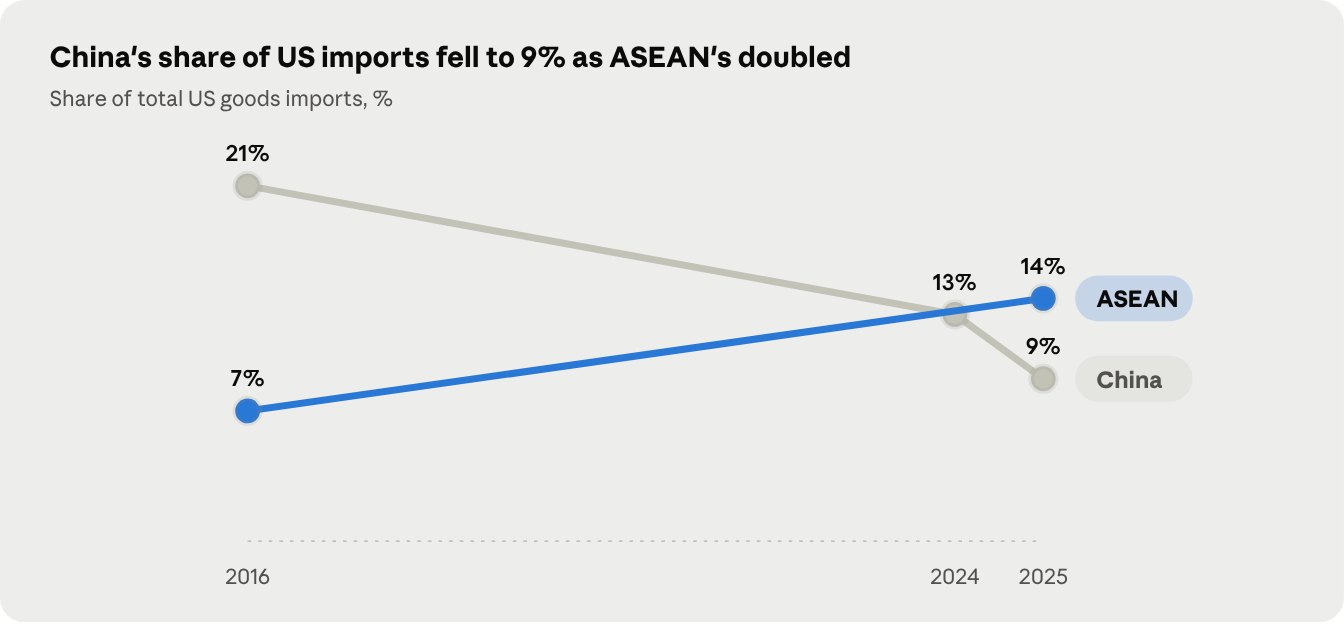
The shift is already well underway. China's share of US imports fell from 21% in 2016 to 9% in 2025, while ASEAN's share doubled from 7% to 14% over the same period.
Tariffs are only part of the story
Vietnam's advantage is real, but it is not a loophole. US authorities are watching closely for Chinese goods routed through Southeast Asia, and Rules of Origin enforcement is tightening. A product that is simply relabeled or lightly finished in Vietnam can still be treated as Chinese and hit with penalty rates.
That is why a real transfer matters: the product must be substantially made in Vietnam, with documentation to prove it. The good news is that a properly run transfer brings benefits beyond tariffs:
Supply chain resilience. A second country of production protects you from a single point of failure.
Competitive labor and growing capability. Vietnam's manufacturing base has matured fast in packaging, electronics, textiles and furniture.
Free trade access. Vietnam's trade agreements open doors to markets beyond the US.
The five-phase transfer playbook
Every transfer is different, but the ones that succeed follow the same discipline: nothing moves until it is proven, and the old source keeps running until the new one is approved.
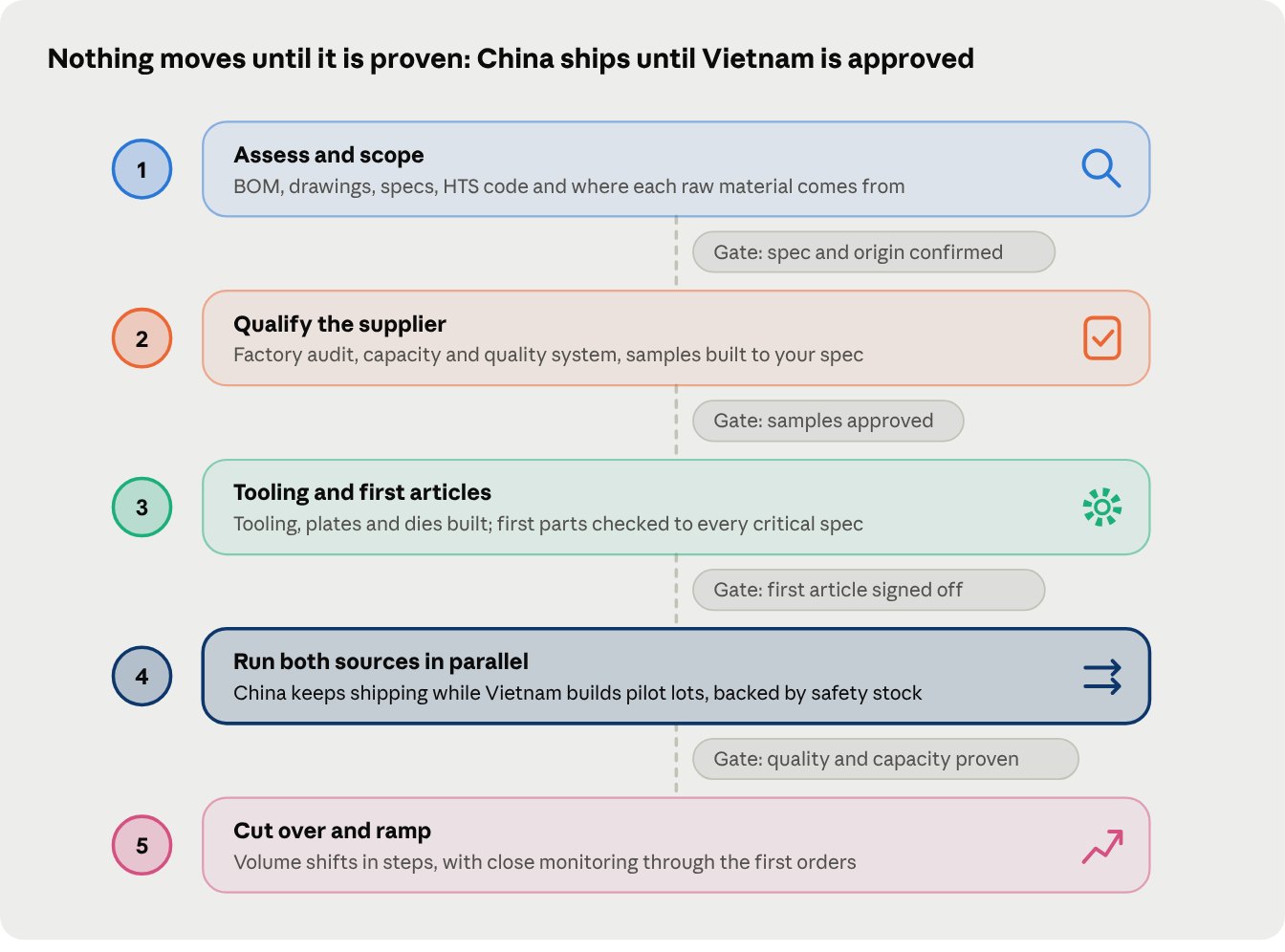
1. Assess and scope. Start with the full bill of materials, drawings, specs and quality requirements. Confirm the HTS code and where each raw material will come from, since that decides country of origin. Decide what moves first: often a stable, high-volume item rather than your most complex one.
2. Qualify the supplier. Audit the factory's equipment, capacity, certifications and quality system against your product. Request samples built to your spec, not catalog samples.
3. Tooling and first articles. Build or transfer tooling, plates and dies. Inspect first-article parts against every critical dimension and print requirement, and sign off before anything ships in volume.
4. Run both sources in parallel. Keep China producing while Vietnam builds pilot and early production lots. Build safety stock to cover the learning curve. Compare quality, yield and on-time delivery side by side.
5. Cut over and ramp. Once Vietnam has proven quality and capacity, shift volume in steps. Keep monitoring closely through the first several orders.
Five mistakes that derail transfers
Moving everything at once. Start with one product family, learn, then expand.
Sending drawings without the know-how. Tribal knowledge — the tolerances that matter, the known failure modes — has to transfer too.
Ignoring where raw materials come from. Chinese inputs with minimal processing can undo the origin benefit.
Shutting off China too early. Without a parallel run, any hiccup becomes a stockout.
No one owning the details on both sides. Time zones, language and expectations need a single accountable owner.
How VIX helps
VIX Manufacturing Solutions is the North American Commercial Office of Dong A Corp., based in Texas, working with established Vietnamese manufacturers Dong A and Nam Phuong. Our team has led manufacturing transfers from RFQ and BOM review through new product introduction and mass production, including running dual-site production until the new site was fully approved.
We specialize in flexible packaging and pouches, printed labels, shrink sleeves and corrugated packaging, and source other categories through our partner network. You work with a US-based team, in English, with Vietnamese-speaking program managers handling the factory side at Dong A and Nam Phuong.
Ready to see what Vietnam could do for your landed cost? Send us your current spec or a sample, and we'll return a quote and a transfer plan. Contact VIX →
Source: The New US Tariff Framework: Implications for Vietnam's Export Sector — Saigon Newport Corp., Aug 3, 2026, citing Allianz Research. Tariff figures as of August 2026.
Related product: A packaging supplier alternative to China →
Want this applied to your packaging?
Send your current spec and we'll come back with a factory-direct quote in 5–7 business days.
Get a quote